
The Soul Fisherman
A narrative folk universe born from the sea, memory, and the breath of local storytelling

What Memory Paints
Some paintings decorate walls. Others haunt the rooms they inhabit. The Soul Fisherman belongs to the second category.
In the world of Pierre Martin Folk Art, every work emerges from a deep conviction: folk art is not an art of the past. It is an art of breath the breath that moves through generations, carries forgotten names, and refuses to let the departed truly disappear.
The Soul Fisherman is one of the most powerful figures in this universe. And his story the tale that gives him a voice is its faithful echo.
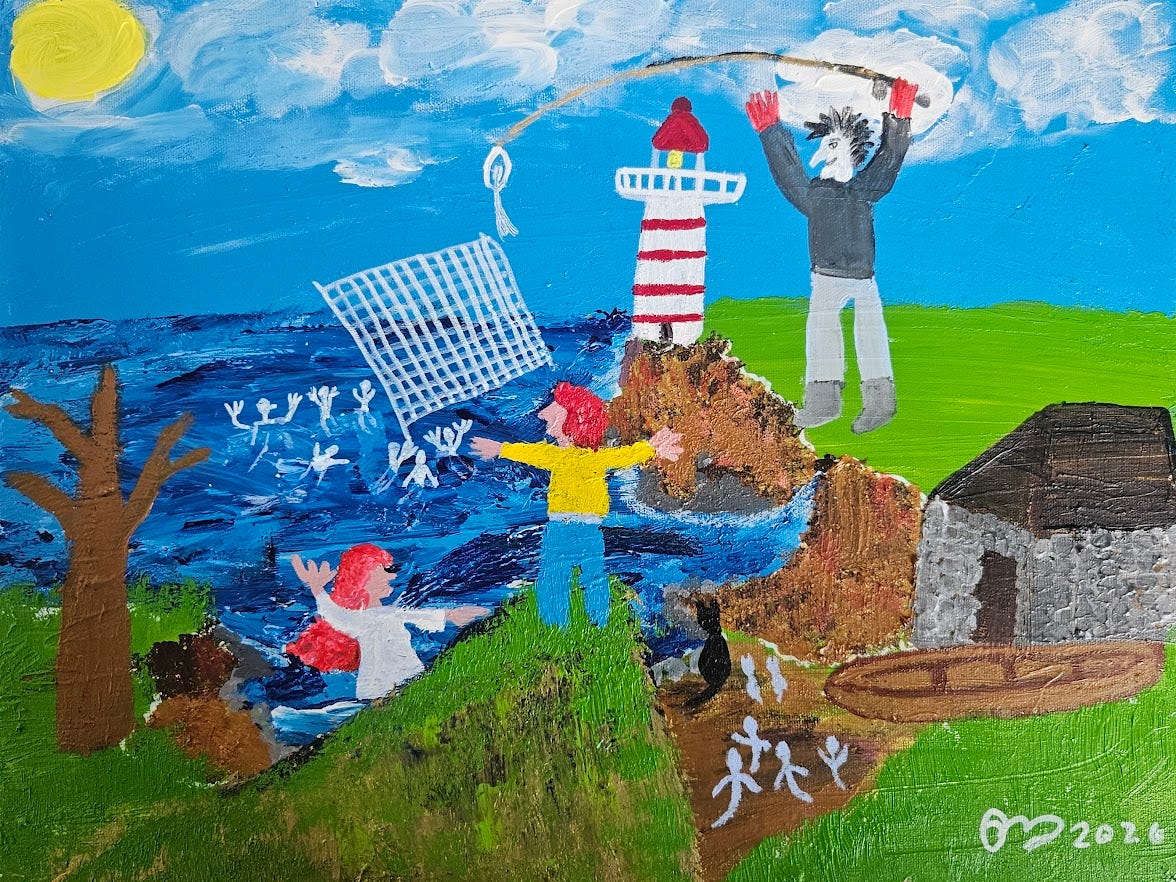
The Soul Fisherman, 14 x 20 inches, Acrylic, 2026
A Tale, A Painting, A World
“At the edge of the world, where the land crumbles into the sea, lived a man known as the Soul Fisherman.”
Thus begins the story. And already, in that very first sentence, we recognize the foundations of an imaginary territory that is also a real one: the Acadian coast, the eastern cliffs, the villages where the sea is closer than the nearest town.
The Fisherman does not catch fish. He retrieves the souls of the drowned, the lost, the forgotten — those swallowed by the sea and claimed by no one. He lays them gently upon the shore and watches them regain their shape, like embers brought back to life with a breath.
“To bring back a soul is to remember someone. It is to speak their name. It is to tell a story.”
This is the heart of the tale and, by extension, the heart of the painting. Memory is not a museum. It is an action. It demands that we cast the net, wet our hands, and accept the weight of what we bring back.
What the Painting Reveals
In this new 2026 canvas — a direct continuation of an earlier foundational work, I expand the universe of the tale through symbolism that is uniquely my own.
At the center stands the red-and-white striped lighthouse: a marker of the living world, guardian of the boundary between sea and land. Nearby, the Fisherman dark and gray, almost stone-like raises at the end of his line a soul twisting in the wind like a kite. This suspended soul, fragile and weightless, embodies the delicate nature of memories held together by only a thread.
To the left, two bright red-haired figures the girl and the boy from the tale stretch their arms toward the water. Their gestures are both pleas and offerings. They do not flee. They move forward.
In the swirling blue water, a white net holds tiny glowing silhouettes: rescued souls still floating between two worlds. On the ground, other small white presences naïve, almost prehistoric drawings remind us that these souls had lives before they were lost.
Jack the Cat, faithful to the bestiary of Pierre Martin Folk Art, watches without intervening. He knows. He keeps watch.
And behind it all: the old stone cabin, the bare tree, the almost piercing green grass beneath a childhood-yellow sun. The palette is bold, direct, without cast shadows — just like true stories.
The Link to the Manifesto: Painting to Give Stories a Body
In the manifesto of Pierre Martin Folk Art, one phrase returns like an anchor:
“I do not paint to illustrate stories. I paint to give them a body.”
The Soul Fisherman is the exact demonstration of this idea. The painting does not merely illustrate the tale. It precedes it, extends it, overflows beyond it. The two works painting and narrative are not in service to one another. Together, they form a single living and recognizable world.
This is what the manifesto calls a narrative folk universe: a space where painting gives legends a body, storytelling gives them a voice, and animated imagery may one day extend their presence beyond the canvas.
The Soul Fisherman is not a character invented for a painting. He is a figure from the imagined heritage of Acadia and Québec an archetype emerging wherever the sea takes and does not return. I seize him, give him a dark face and a sweeping gesture, and restore him to living memory.
Learning Opportunities: What This Tale Teaches
The tale of the Soul Fisherman is not merely a beautiful story. It carries lessons learning opportunities for children, families, and educators seeking to pass on a living culture.
Memory as an Act, Not as the Past
The tale shows that remembering is not passive. To bring back a soul is to act to speak a name, tell a story, cast the net. This image invites reflection on the role of family, community, and storytelling in cultural transmission.
The Courage to Approach What We Do Not Yet Understand
In the tale, the girl steps forward where the boy hesitates. She takes hold of the net and feels the full weight of what it carries. This scene teaches that curiosity, even in the face of the unknown, is a virtue. Understanding comes only after daring.
Intergenerational Cooperation
The Fisherman elderly, solitary, silent and the two red-haired children work together that night. None of them could accomplish alone what they achieve together. A simple and universal lesson about the transmission of knowledge between generations.
Stories as Living Heritage
The tale ends with a question:
“And you which soul do you remember tonight?”
This direct invitation transforms the story into a tool for dialogue. At home, in classrooms, or in cultural workshops, it opens a space for people to share their own memories.
Acadian and Québécois Identity as a Universal Symbolic Heritage
In my view, the Soul Fisherman belongs to a tradition of legendary figures the wolf-charmer, the Chasse-galerie, the Corriveau that are part of a rich collective imagination often unknown beyond our borders. I turn it into a universal proposition: the voices most deeply rooted are also the ones that travel the farthest.
Pierre Martin
Naïve Folk Artist · Storyteller
© 2026 Pierre Martin Folk Art — Québec & Acadia