
The Werewolf of Lunenburg: Between Folk Art and a Biting Legend

By Pierre Martin
In the small coastal town of Lunenburg, Nova Scotia, stories tend to stick around. All it takes is a glance at the morning fog or the snap of a branch deep in the woods, and the imagination stirs. It’s here that one of Eastern Canada’s most distinctive artists lives and works: Bradford Naugler, a leading figure in folk and naïve art.
In his world, folklore never sleeps. It takes form—literally. And one of his most striking pieces draws from a local whisper: the legend of a half-man, half-wolf creature that has haunted the region since the early colonial days.
A Textile Beast with a Piercing Stare
Hanging on the wall of a modest interior, the piece immediately commands attention. A carved wolf’s head, complete with ominous horns, crowns a textile body covered in cryptic patterns. It’s not quite a painting, not quite a sculpture—it's a presence. A revenant suspended between past and present.
The red dominates, black deepens the shadows, and the whole work evokes both Indigenous symbolism and European folktales. This one-of-a-kind creation, which Bradford simply calls The Werewolf, watches over the threshold like a spirit from another time.
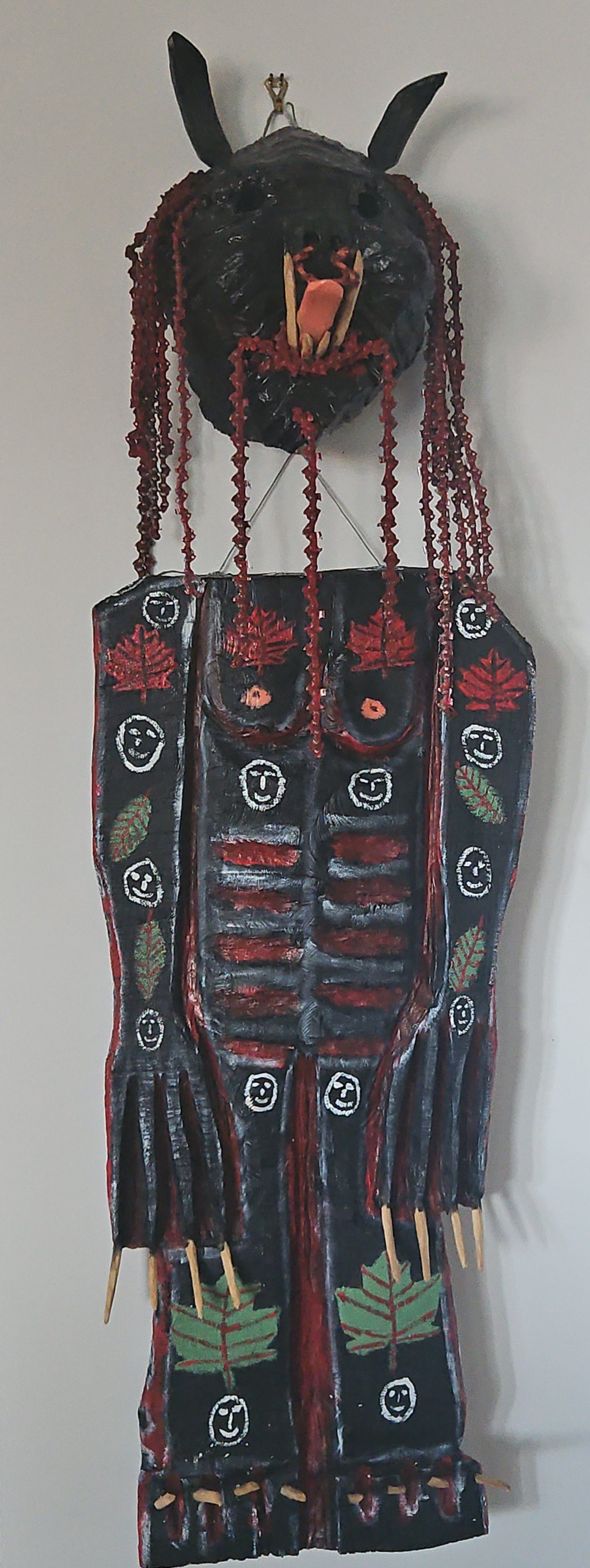
A Local Myth, Reimagined
Inspired by stories passed quietly around kitchen tables and over plowed fields, Bradford shaped his own version of the Lunenburg werewolf. The tale varies depending on the storyteller: some say it was a jealous husband, others speak of a grief-stricken survivor, a shape-shifter, or even a vengeful spirit.
But most agree: the beast would appear on full-moon nights, when mist swallowed the trails. Livestock found torn apart. Unnatural howls cutting through the dark. And always, a shadowy figure, part man, part dog, roaming without purpose—or worse, with a purpose better left unknown.
Art That Refuses to Forget
What sets Bradford Naugler apart is his ability to give form to invisible stories. Without academic training or marketing gloss, he works by instinct, as though he’s carving directly into collective memory.
This piece isn’t meant to frighten—it’s meant to preserve. Like a Maritime griot, Bradford reminds us that naïve art isn’t “simple” art—it’s honest art. And honesty remembers.
Lunenburg: A Land of Legends
Nova Scotia is fertile ground for ghost stories, sea monsters, and old maritime secrets. Lunenburg—with its brightly colored houses and sloping graveyards—is a perfect stage for tales with hidden depths.
In this setting, the werewolf imagined by Naugler doesn’t howl. It warns. It stands still, but it speaks volumes.
Conclusion: When Folklore Still Bites
Bradford Naugler’s work isn’t just an homage to a local legend. It’s a successful attempt to keep something alive—something we might otherwise dismiss with a rational shrug. His werewolf reminds us that monsters don’t just live in the woods. They live in our stories, our walls, our memories.
And sometimes, they watch us. Quietly. From the living room.